


Why Total Cost of Ownership Matters in Modern Manufacturing
 At a recent technical session with Intralox in Birmingham, members of the Noreside Engineering team explored a topic that continues to reshape capital investment decisions across the food and pharmaceutical sectors: Total Cost of Ownership (TCO).
In highly regulated environments, where uptime, hygiene, and efficiency directly impact profitability, the true cost of a system goes far beyond its initial purchase price.
Moving Beyond the Purchase Price
One of the key takeaways from the session is simple but often overlooked: the cheapest system upfront is rarely the most cost-effective over time.
TCO is typically defined as the full lifecycle cost of an asset — from acquisition and installation through to operation, maintenance, and eventual replacement.
As highlighted by Intralox, decision-makers must look beyond the “price tag” and consider the complete financial impact of equipment across its lifespan. (intralox.com)
Breaking Down the Real Cost Drivers
1. Installation & Downtime Costs
Initial investment includes more than equipment. Labour for installation, system integration, and production downtime all contribute significantly to upfront cost.
Even short delays in commissioning can have a measurable impact on output and revenue.
2. Operational Efficiency
Energy usage, throughput, and system design all influence long-term operating costs.
Well-designed automation systems reduce waste, improve flow, and increase consistency — delivering measurable gains in output over time.
3. Labour & Training
Labour remains one of the largest and most volatile cost factors in manufacturing.
According to insights shared by Intralox, equipment that is complex to operate or clean increases both training requirements and ongoing labour costs. (intralox.com)
In contrast, intuitive, hygienically designed systems reduce dependency on specialised skills and minimise operational risk.
4. Maintenance & Reliability
Maintenance is often one of the most underestimated contributors to TCO.
Poorly specified systems can lead to:
• Frequent breakdowns
• Increased spare parts usage
• High maintenance labour costs
• Unplanned downtime
In some cases, companies normalise these inefficiencies — accepting them as part of operations rather than addressing root causes.
5. Hygiene & Cleanability
In food and pharmaceutical environments, hygiene is directly linked to cost.
Systems that require long cleaning cycles reduce production uptime. As highlighted in Intralox insights, every minute spent cleaning is a minute not producing. (intralox.com)
Hygienic design can significantly reduce sanitation time, improve compliance, and increase available production hours.
6. Flexibility & Future-Proofing
Modern manufacturing demands adaptability.
Equipment that can handle multiple product formats or respond to changing market demands reduces the need for future capital investment.
Flexible systems not only improve resilience but also increase long-term ROI by extending asset usability.
The Hidden Cost of “Cheap” Equipment
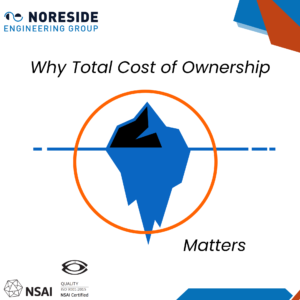
A key theme from the Birmingham session was the “iceberg effect” — where the visible cost (purchase price) represents only a fraction of the total expense.
Hidden costs often include:
• Downtime and lost production
• Excessive maintenance
• Labour inefficiencies
• Cleaning and sanitation time
• Energy consumption
Over time, these can outweigh any upfront savings many times over.
As industry guidance highlights, correctly specified systems can significantly reduce operational and maintenance costs across the equipment lifecycle. (Conveyormag)
What This Means for Automation Projects
For engineering teams and plant managers, the implication is clear:
Investment decisions should be based on performance over time — not just initial cost.
At Noreside Engineering, this approach is central to how systems are designed and delivered:
• Hygienic, compliance-led design (GMP, EHEDG)
• Automation systems built for uptime and maintainability
• Integration that reduces complexity and labour dependency
• Solutions engineered for long-term efficiency
A Smarter Approach to Capital Investment
Total Cost of Ownership is not just a financial metric — it’s a strategic tool.
By evaluating systems through a TCO lens, manufacturers can:
• Improve ROI on capital expenditure
• Reduce operational risk
• Increase production uptime
• Deliver long-term cost savings
As demonstrated through insights from Intralox, the most successful projects are those that consider the full lifecycle from day one — not just the initial investment.
Total Cost of Ownership becomes particularly important when evaluating equipment such as process skids, conveyor systems, and IBC cleaning solutions. While these systems may appear comparable at the point of purchase, differences in hygienic design, energy efficiency, and maintenance requirements can significantly impact long-term operational cost. For manufacturers operating in food and pharmaceutical environments, these hidden costs often determine the true return on investment.
Final Thoughts
In today’s manufacturing environment, where margins are tight and performance expectations are high, understanding TCO is no longer optional.
It is essential.
The real question is no longer:
“What does this system cost today?”
But rather:
“What will it cost us over the next 5–10 years?”