


Beverage Processing Automation: The Complete Guide for Modern Manufacturers
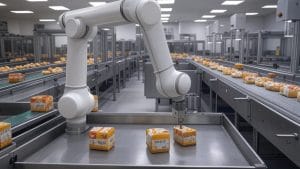 Beverage manufacturers are under more pressure than ever. Consumers expect consistent quality, SKU counts keep climbing, and margins remain razor thin. The answer an increasing number of producers are turning to is **beverage processing automation** — technology that handles repetitive, precision-dependent tasks faster, more accurately, and more safely than manual labour ever could.
This guide covers everything from what beverage processing automation actually means on the plant floor, to where beverage and food manufacturing automation delivers the highest ROI, to how to build a roadmap that fits your operation.
What Is Beverage Processing Automation?
Beverage processing automation is the use of programmable machinery, sensors, control systems, and software to execute and monitor production tasks with minimal human intervention. It spans the entire value chain — from raw ingredient intake and blending through to filling, capping, labelling, and palletising.
Unlike simple mechanisation (a pump is a pump), automation implies closed-loop control: the system measures what is happening, compares it to what *should* be happening, and corrects the process in real time. A flow meter detecting an off-spec fill volume and signalling the filler to compensate — without an operator lifting a finger — is a simple but representative example.
Modern beverage manufacturing automation typically involves three layers:
- Field / device Physically moves, measures, or controls | PLCs, VFDs, sensors, actuators, robots |
- SCADA / HMI Visualises and supervises the process | Wonderware, FactoryTalk, IgnitionSCADA |
- MES / ERP Plans, schedules, and analyses production | SAP, Plex, Rockwell FactoryTalk |
Integration across all three layers is what separates a truly automated facility from a collection of automated islands.
Why Beverage and Food Manufacturing Automation Is Accelerating
Labour availability and cost
Filling, capping, and quality inspection lines run three shifts. Finding reliable operators willing to work those hours has become structurally difficult in most markets. Automation does not call in sick and does not require shift premiums.
Hygiene and food safety compliance
Regulatory standards — FSMA in the US, BRC globally, local dairy or alcohol codes — are tightening. Automated CIP (clean-in-place) systems deliver documented, repeatable sanitation cycles that reduce both contamination risk and audit anxiety.
Consumer demand for variety
A craft brewery running 40 SKUs faces radically different changeover demands from one running 4. Flexible automation — quick-change filling heads, recipe-driven blending, auto-adjusting labellers — makes high-mix production viable without sacrificing throughput.
Data and traceability requirements
Retailers and regulators increasingly demand lot-level traceability. Automated systems generate the timestamps, sensor readings, and batch records that manual processes cannot reliably produce at scale.
Key Areas of Beverage Processing Automation
1. Ingredient Handling and Blending
Automated weigh batching and liquid dosing systems replace manual scooping and measuring. Inline conductivity, Brix, and pH sensors verify every batch before it advances. Recipe management software stores hundreds of formulations and drives the automation directly — eliminating transcription errors entirely.
ROI driver: Reduced giveaway on expensive ingredients (flavours, concentrates, sweeteners) and fewer batch failures.
2. Pasteurisation and Thermal Processing
Plate heat exchangers and tunnel pasteurisers are already heavily automated in most large facilities, but smaller producers still rely on manual temperature checks and paper logs. Modern control packages provide continuous temperature monitoring, automatic hold-tube diversions on deviation, and electronic batch records accepted by auditors.
ROI driver: Consistent product safety without depending on operator vigilance at 3 a.m.
3. Filling and Packaging
This is where most beverage manufacturers focus first, and for good reason. Automated filling lines offer:
– **Volumetric or gravimetric fill accuracy** to ±0.1% or better
– **Automatic format changeover** via servo-driven adjustments
– **Vision systems** for cap presence, fill level, and label placement
– **Integrated rejection** — no manual sorting of defective units
High-speed rotary fillers for cans and PET bottles can exceed 1,000 containers per minute. Even smaller inline fillers running at 60–100 BPM deliver accuracy and hygiene standards impossible to match manually.
4. Clean-in-Place (CIP) and Sanitation Automation
In food and beverage manufacturing, cleaning is production. A 10-minute reduction in CIP cycle time across three tanks, twice a day, frees significant capacity. Automated CIP systems control chemical concentration, temperature, flow rate, and contact time — and generate the documentation to prove it.
ROI driver: Faster changeovers, reduced chemical consumption, and defensible audit records.
5. Palletising and End-of-Line Logistics
Robotic palletisers handle layer patterns that change by SKU, stack heavy cases all shift without fatigue, and fit into floor footprints conventional machinery cannot. Collaborative robots (cobots) increasingly work alongside operators for tasks like case erecting or bundle wrapping where full automation would require complex guarding.
6. Quality Inspection
Machine vision cameras check every container at line speed for fill level, label alignment, cap torque, and code legibility. Inline spectroscopy systems verify product composition without sampling delays. Automated statistical process control (SPC) software flags drift before it becomes a quality incident.
Beverage Manufacturing Automation vs Food Manufacturing Automation: Key Differences
Beverage processing automation and broader food manufacturing automation share most of the same underlying technologies — PLCs, robots, vision systems, MES — but beverage lines have some specific characteristics:
– **High liquid volumes at speed:** Filling precision requirements are tighter and cycle times faster than most dry-food operations.
– **CO₂ and alcohol handling:** Safety interlocks and explosion-proof ratings apply in brewing, winemaking, and spirits.
– **CIP frequency:** Beverage lines typically clean more frequently than many dry-food lines, making CIP automation especially valuable.
– **Carbonation control:** Inline dissolved CO₂ monitoring is a beverage-specific automation challenge with direct impact on product quality.
For manufacturers producing both food and beverages, unified MES and ERP platforms that handle both product families reduce integration complexity and provide a single view of plant-wide OEE.
Common Questions About Beverage Processing Automation
Is automation only for large producers?
No. Compact, modular filling lines, entry-level SCADA packages, and cobot palletisers have pushed accessible automation well below the volumes that justified it a decade ago. A craft brewery producing 5,000 HL/year can automate meaningfully today.
What is a realistic payback period?
For filling line automation, 2–4 years is typical. CIP automation and energy management systems often return investment faster. Complex robotic lines with significant integration work may take 4–6 years, though labour savings compress that significantly in high-wage markets.
How do I justify the capital expenditure internally?
Build your business case around labour savings, reduced giveaway and rework, avoided food safety incidents (value a recall at your revenue exposure), and OEE improvement. A 5-point OEE gain on a $20M/year line is $1M in recovered capacity — with no additional fixed costs.
The Bottom Line
Beverage processing automation is no longer a competitive advantage reserved for multinationals. The technology is accessible, the ROI is demonstrable, and the labour and compliance pressures are universal. Whether you are a regional juice brand modernising an ageing filler or a national brewer consolidating to a fewer, more efficient lines, a structured approach to **beverage manufacturing automation** — prioritising your real constraints, planning for integration, and investing in your people — is the foundation of a more competitive, resilient operation.
Producers who begin that journey now will be better positioned to absorb the next wave of consumer demand, regulatory change, and cost pressure than those who wait.
Looking to explore automation options for your facility? Speak with our engineering team about a no-obligation line assessment.
Contact Us
"*" indicates required fields
FANUC robotics in Ireland — integration, programming & support